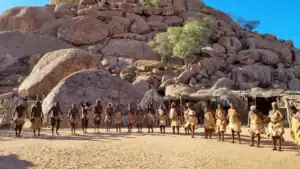
Rhino tracking in Damaraland is unlike any other wildlife experience in Africa. Deep in Namibia’s northwest Kunene region, expert trackers lead you through vast, untamed wilderness in search of free-roaming desert-adapted black rhino, among the rarest animals alive. Wild and unhabituated, sightings are never guaranteed — this is black rhino tracking in Namibia at its most authentic. But that is exactly what makes it extraordinary.
What is Rhino Tracking in Damaraland?
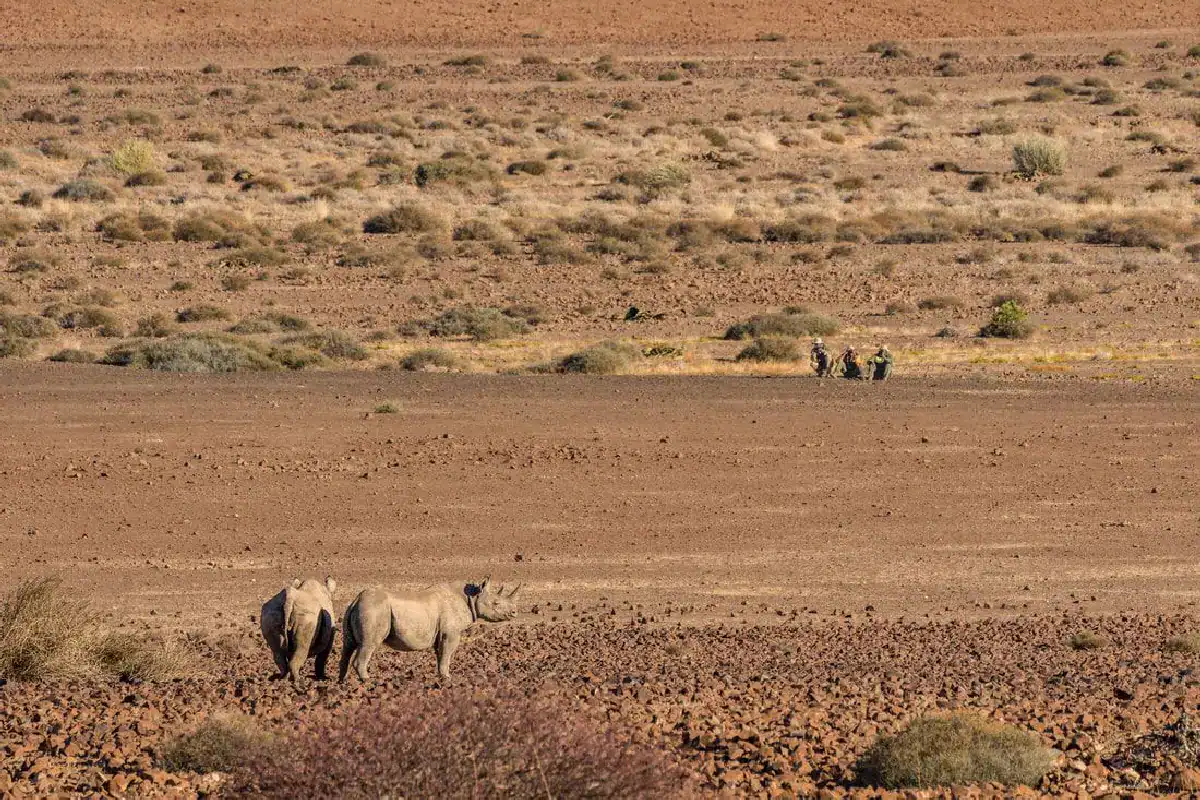
Damaraland rhino tracking means joining Save the Rhino Trust (SRT) rangers on foot and by vehicle across the Palmwag Concession — a genuine wilderness experience, not a staged encounter or a game drive where animals appear on schedule. Expert trackers set out on foot before first light across vast, rugged terrain. They read the landscape for signs that most visitors would never notice — a scuffed rock, a snapped branch, a trail through the dust. The rhinos carry no collars and no GPS tags. They are found through skill, patience and decades of accumulated knowledge.
What makes this harder than it sounds: desert-adapted black rhino are almost invisible against the dark volcanic basalt of the Damaraland landscape. They have poor eyesight but acute hearing and smell — approach from the wrong direction and they will charge. Every tracking excursion follows strict protocols. You travel by vehicle until trackers radio that a rhino has been located. Then you continue on foot — downwind, in silence, in single file — to within 30 to 80 metres of a genuinely wild animal.
You do not find the rhino. The trackers find the rhino. You follow the trackers.
Why Damaraland? Namibia’s Rhino Capital
This is where black rhino tracking in Namibia is at its most concentrated. Namibia has the world’s largest black rhino population — approximately 2,100 to 2,200 individuals. The Kunene region alone, encompassing Damaraland and the Palmwag Concession, is home to more free-roaming black rhino than anywhere else on Earth. Globally, an estimated 6,788 black rhino remain in the wild, and they are classified as critically endangered.
What makes the desert-adapted black rhino of Damaraland exceptional is not just their rarity — it is how they survive. Unlike standard black rhino, these animals have evolved over generations to live in one of the harshest environments on earth. They roam vast home ranges of 500 to 2,000 km² in search of food and water. They travel primarily at night to conserve moisture, and can go without water for up to four or five days. They survive instead on moisture extracted from Euphorbia damarana, a succulent so toxic it is lethal to humans, which the desert-adapted black rhino can digest without harm.
What to Expect on a Rhino Tracking Experience
Expect an early start (06h00–06h30), a long drive across ancient terrain, and a genuine sense of not knowing what the day will bring. A rhino tracking excursion in Damaraland is not a conventional safari activity. It is an expedition into one of Africa’s most remarkable wilderness areas in search of an animal that does not want to be found.
Your day will combine open vehicle driving with rhino tracking on foot across Namibia’s rocky, uneven terrain. The time on foot varies considerably. Excursions are typically half day (approximately 5–6 hours) or full day, with full day options generally including a bush lunch in the field.
The encounter itself — if it happens — is brief, intimate and conducted at a respectful distance. No sudden movements, no phone sounds, and staying grouped with your trackers are essential. Many visitors describe it as one of the most profound wildlife encounters of their lives. Others return without a sighting. Both outcomes are part of what makes this experience authentically wild.
Reasonable fitness is required. Minimum age restrictions vary by operator — ranging from 12 to 16 years. Always confirm directly when booking. Wear neutral coloured clothing, sturdy closed shoes and carry at least two litres of water.

The Palmwag Concession — The Landscape
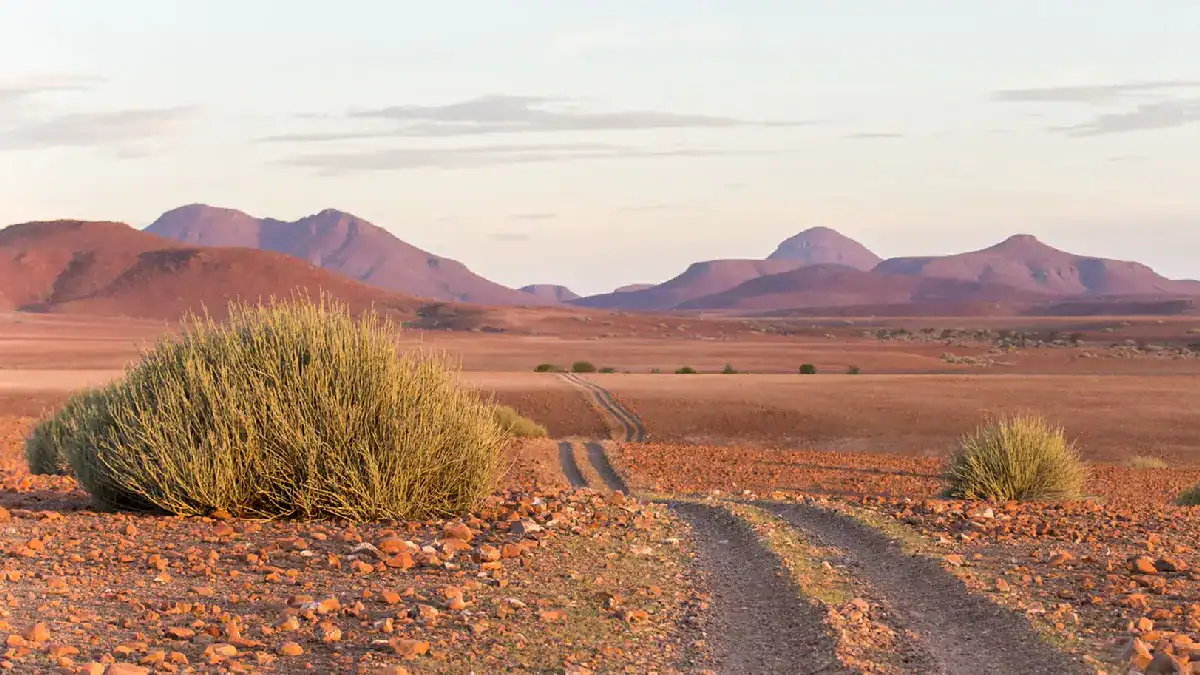
The Palmwag Concession covers approximately 582,000 hectares (5,820 km²) of north-western Namibia — one of the most remote and pristine wilderness areas on the continent. The landscape is ancient Namibian basalt — dark volcanic rock that erupted 125 million years ago. It’s punctuated by dry riverbeds — the Uniab, Aub and Barab — along with seasonal springs and vast open plains.
Wildlife is remarkable given the apparent hostility of the environment. This is where Namibia’s wildlife experiences are at their richest — desert-adapted elephant, giraffe, Hartmann’s mountain zebra, oryx, springbok, and occasionally desert-adapted lion and leopard all share this landscape. Namibia’s desert-adapted black rhino remain the primary reason most visitors make the journey here.
The Conservation Story — Save the Rhino Trust
Save the Rhino Trust in Namibia was founded in 1982 by Blythe Loutit — an artist, author and passionate conservationist. She began monitoring the last remaining desert-adapted black rhino in the Kunene region using her private Land Rover, funded by the sale of her own artwork. In 1982, fewer than 40 black rhino remained in Damaraland. That number has grown steadily since — to around 90 by 2000, 130 by 2010, and approximately 200 by 2024. What started with a handful of rangers and a few thousand rand has become one of Africa’s most enduring wildlife conservation partnerships, and the Kunene region is now home to the largest free-roaming black rhino population outside any national park on Earth.
SRT rangers are recruited from the very communities whose land the rhinos roam. They patrol over 5.7 million acres of the Palmwag Concession and surrounding Kunene region — on foot, by vehicle and on horseback. They monitor individual desert-adapted black rhino in Namibia whether guests are present or not, maintaining the longest running photographic and life history database of black rhinos in the world. Many animals are known individually to rangers — identified by ear notches, horn profiles and the unique pressure marks of their three-toed footprints in the sand. In the Palmwag Concession, rangers know rhinos by name: Dave, Katri, Ase, Tuta (daughter of Kasper), Kangombe, Kasper and Arthur. Kangombe — a legendary 38-year-old bull identified by a distinct split in his front horn and a ripped right ear — has been monitored for decades.
When you join a rhino tracking excursion in Damaraland, a portion of the fee is paid directly to the local conservancies — Torra, Anabeb and Sesfontein. Your visit is not just an experience — it is rhino conservation tourism that Africa can be proud of.
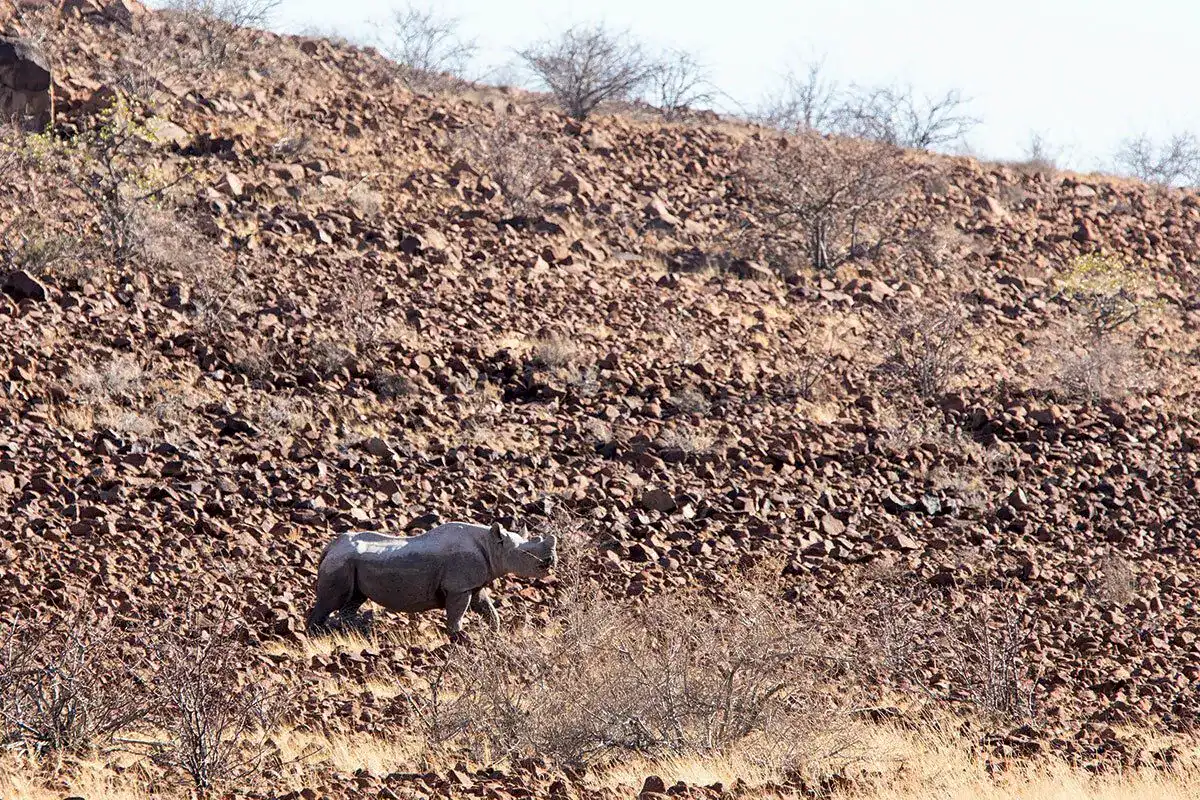
A black rhino makes its way across the rocky hillside of the Palmwag concession Cr.Melanie Freeman
Where to Stay for Rhino Tracking in Damaraland
Rhino tracking in the Kunene region is available from three distinct base areas: the Palmwag Concession, the Grootberg Conservancy, and the Sesfontein and Hoanib River area. Each offers a different experience. Within the Palmwag Concession in north-western Namibia, Desert Rhino Camp is the flagship option. This extremely remote property, with contemporary canvas and stone suites, is run by Wilderness Safaris in partnership with the Save the Rhino Trust. The Grootberg Conservancy offers rhino tracking through Grootberg Lodge — community-owned, with spectacular views over the Klip River Valley.
In the Sesfontein and Hoanib River area, Sesfontein Guest House offers rhino tracking as part of multi-night Sleep-Out packages into the Hoanib riverbed.
You do not need to stay at a luxury lodge — accommodation ranges from remote fly-in camps to self-drive campsites across all three areas. It is strictly illegal to track rhino without a registered ranger or guide.
Rhino tracking is also available in other parts of Namibia. Rhino tracking at Waterberg Wilderness offers a different but equally rewarding experience in central Namibia.
For a full overview of Damaraland accommodation options, visit our dedicated lodges and camps guide.
Practical Information — Booking and Getting There
Booking
Tracking excursions cannot be booked independently — all excursions must be arranged through your lodge or camp, such as Desert Rhino Camp. Self-drive campers can arrange excursions through the relevant lodge reception. A minimum of two persons is required per excursion.
Pricing varies significantly by property and structure. At Grootberg Lodge, the rhino tracking activity is a standalone fee, from approximately N$3,200 to N$3,800 per person, in addition to accommodation. A minimum two-night stay is required to book the excursion.
At Desert Rhino Camp, tracking is included within the nightly rate, from approximately N$15,340 per person sharing, per night, depending on season.
At Sesfontein Guest House, rhino tracking is offered as part of a multi-night Sleep-Out package, from approximately N$4,300 per person. This covers one night at the guesthouse, a full day of tracking, and one night camping in the bush. Rates change seasonally and annually — always confirm current pricing when booking.
Rhino tracking is possible year-round, though the dry season (May to October) offers the best conditions — cooler temperatures, no rain to wash away tracks, and animals concentrating near remaining water sources.
Getting There
The Palmwag Concession in Namibia is the primary rhino tracking destination in Damaraland. Key driving distances to Palmwag:
- From Windhoek — approximately 586 km — approximately 6 hours via the B1, C38 and C40, through Otjiwarongo, Outjo and Kamanjab.
- From Swakopmund — approximately 424 km — approximately 5 hours via Uis.
- From Etosha (Andersson Gate) — approximately 292 km — approximately 3 hours 45 minutes via the C38 and C40, through Kamanjab.
A 4×4 is essential throughout. Fuel up in Kamanjab or Outjo before heading into the concession — petrol stations are scarce beyond these towns. Luxury camps within or near the concession are also accessible by light aircraft — a popular option for fly-in safari guests.