
Car Hire in Namibia: Compare 4x4 & Self-Drive Rental Companies
Find the perfect 4x4 for your Namibia adventure.
Namibia is built for self-drive travel — around 90% of its roads are gravel, and the right vehicle changes what a trip actually feels like. This page brings together every car hire company listed on BookNamibia in one place, along with the region-by-region guidance you need to choose the right vehicle before you book. Every enquiry goes directly to the rental company. No booking fees, no commission, no middlemen.

Tim
Owner – Book Namibia
Local Expert Insight - 21 Years of Driving in Namibia
“I’ve been travelling across Namibia for over 21 years, regularly visiting lodges and remote areas throughout the country. If you’re planning a self-drive holiday, I strongly recommend hiring a 4×4 — especially once you leave tarred roads. With around 90% of Namibia’s roads not tarred, a 4×4 offers far better control, safety, and flexibility on gravel and uneven terrain.”
21+
Years exploring Namibia
100,000+ km
Hundreds of thousands of kilometres travelled across Namibia
40+
Remote areas visited
Countless
Memories & amazing experiences
Why Book Car Hire Through BookNamibia
No booking fees or commission — the rate you're quoted is the rental company's own rate.
Every enquiry goes directly to the car hire company, not a call centre.
A wide range of 4x4, camping-equipped, SUV, budget and luxury vehicles across multiple Namibian operators.
Trusted, established local providers with real experience of Namibia's roads and conditions.

Request a Quote from Trusted Namibia Car Hire Companies
Every car hire company listed on BookNamibia appears here on equal footing — sorted by the same criteria for every visitor, not curated or ranked by us. Compare fleets, ratings and specialisations, then send your enquiry directly to the company that best fits your route and budget.
Africa on Wheels
AfriCar Car Hire
Asco Car Hire
Camel Car Hire Namibia
Caprivi Car Hire
Drive Namibia Car Hire
Gracious Whisp Car Rentals
Namibia Car Rental
Odyssey Car & 4×4 Hire
Osino Car Hire
Pro-Ex Car Rental
Savanna Car Hire

Choose the Right Vehicle for Your Self-Drive Trip
Different regions and itineraries call for different vehicles. Here’s how to think about the choice:

4x4 Vehicles
Typically double-cab vehicles (“bakkies” locally, pickup trucks elsewhere), and the most common choice for Namibia self-drive. Built for gravel roads, national parks and remote areas, with the ground clearance and traction that most of the country’s routes call for.
- Built for rough and off-road conditions
- High ground clearance and strong 4x4 capability
- Ideal for remote destinations and adventurous itineraries

Camping 4x4 Vehicles
A 4×4 equipped with a rooftop tent, fridge, cooker and camping gear — everything needed for an independent, self-catering route where accommodation isn’t booked in advance every night.
- Rooftop tent and comfortable bedding
- Camping equipment included (fridge, cooker, table, chairs etc.)
- Everything you need for independent travel

SUV Vehicles
More comfortable on tarred roads and long distances, and well suited to a lodge-based itinerary. Most models offer 4×4 capability but are generally less suited to deep sand or the roughest gravel.
- Comfortable and spacious
- Ideal for longer road trips and lodge stays
- Best for tarred roads and good quality gravel

Budget Vehicles
Older, higher-mileage vehicles at a lower daily rate — a practical option for travellers keeping mainly to tarred roads between larger towns.
- Affordable daily rates
- Well-maintained and reliable
- Great value for cost-conscious travellers

Luxury Vehicles
Newer 4×4 or SUV models with premium features, for travellers who want extra comfort and space on a longer or higher-end route.
- Newest models with premium features
- Maximum comfort and space
- Ideal for long-distance and high-end travel

Self-Drive Car Hire by Region
Namibia isn’t one road trip, it’s several — the right vehicle for the coast isn’t necessarily the right one for Damaraland or the far south. Here’s what to expect region by region.

Windhoek & Central Namibia
Most rentals start and end in Windhoek, generally via Hosea Kutako International Airport, around 45km outside the city. Roads in and around Windhoek are tarred, so a standard SUV or sedan is sufficient if your trip stays close to the capital — the vehicle question really only becomes a 4×4 discussion once you head out toward gravel routes and remote regions.

Swakopmund, Walvis Bay & the Coast
The B2 route from Windhoek to Swakopmund and Walvis Bay is fully tarred, making this an easy leg for most rental vehicles. Coastal fog can reduce visibility, particularly in the mornings, and several of the region’s signature activities — dune driving, Sandwich Harbour — are run as guided 4×4 excursions rather than self-drive, so a 4×4 rental isn’t essential here unless your onward route requires it.

Damaraland & Kunene
A 4×4 is recommended throughout Damaraland, in every area and every season — this is gravel and sand driving country, with genuinely long distances between fuel stops. The Kamanjab–Palmwag stretch in particular has no reliable fuel for roughly 200km, so plan refuelling carefully and carry extra fuel on any route that takes you deep into the region. See our Damaraland accommodation guide for how this affects route planning.

Etosha, Waterberg & Northern Namibia
Roads inside Etosha National Park are well-maintained gravel, and a 4×4 is the best option for the fullest, most flexible self-drive experience across the park’s rest camps and waterholes. The wider region, including the Waterberg Plateau, mixes tarred and gravel routes — check your specific itinerary against your vehicle before booking.
Sossusvlei & the Namib
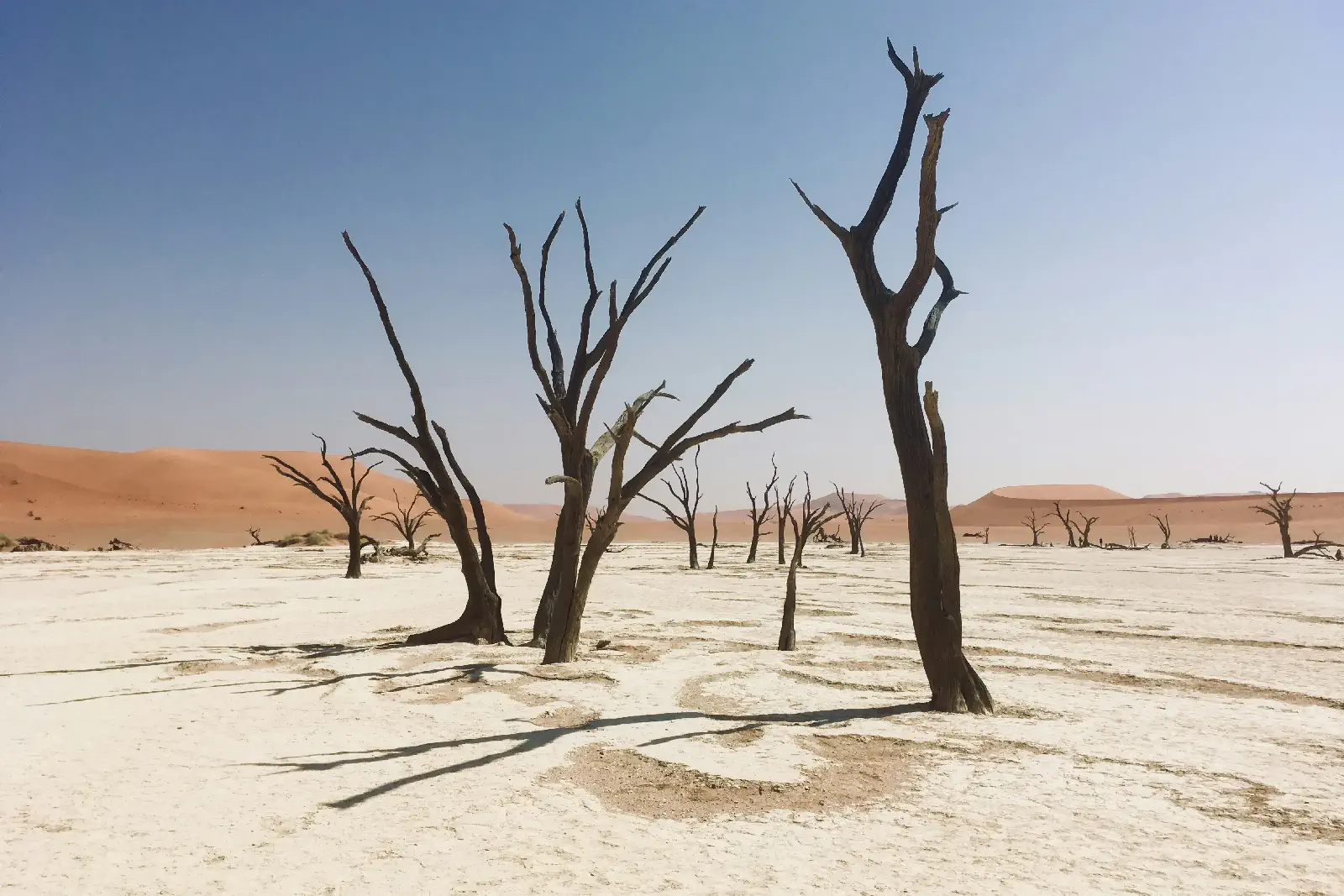
The route to Sesriem is tarred, but the final stretch — around 6km — into Sossusvlei and Dead Vlei crosses deep sand and requires a 4×4 transfer. Many self-drive travellers hire a 4×4 for the wider Namib leg of their trip specifically to avoid needing a separate transfer vehicle at the gate.

Kalahari, Lüderitz & Southern Namibia
The south is Namibia’s quietest, most remote driving region — long, straight gravel roads connecting the Kalahari, Lüderitz, Kolmanskop and the Fish River Canyon, often with significant distances between fuel and services. A high-clearance 4×4 is recommended here for the same reason it matters in Damaraland: the roads themselves may be passable, but the distances and lack of backup make margin for error worth having.

Kavango & the Zambezi (Caprivi) Region
The Zambezi Region is a different landscape entirely — green, river-defined, and largely connected by the tarred Trans-Caprivi Highway. Main routes are manageable in a standard SUV; a 4×4 becomes useful mainly for reaching specific lodges or river-access points off the main road.
Essential Information for Your Self-Drive Trip
After more than 21 years of travelling across Namibia, here are the most important things to know before choosing your vehicle.
Real Advice. Real Experience. Better Trips.
Roads, Driving & Common Mistakes
Namibia’s main routes are tarred, but most travel — especially to lodges, national parks and remote regions — involves gravel. Adjust your speed on gravel, allow extra travel time, and avoid driving after dark, when wildlife and livestock on unlit roads are the main hazard. The most common planning mistakes are underestimating driving times, not planning fuel stops, and trying to cover too much distance in too short a time — gravel travel is slower than it looks on a map.
Fuel & Distances
Distances between towns and fuel stations can be considerable, particularly in Damaraland, the Skeleton Coast and Kaokoland. Refuel whenever the opportunity arises rather than waiting until the tank runs low, and carry extra fuel on any route that takes you more than 150km from a confirmed fuel source.
Insurance
Most rentals include basic insurance with an excess amount. Because gravel roads make tyre punctures and windscreen chips more common than on tarred roads, additional cover — Collision Damage Waiver, tyre and windscreen protection, undercarriage cover — is worth checking before you collect your vehicle.
Driver's Licence & Documents
Tourists can drive in Namibia on a valid driver’s licence issued in English; if yours isn’t in English, you’ll need an International Driving Permit alongside your original licence. You’ll also need a valid passport and a credit card in the main driver’s name for the security deposit.
Airport Transfers
Most international visitors arrive via Hosea Kutako International Airport, roughly 45km from Windhoek. Many car hire companies offer shuttle or transfer services between the airport and their Windhoek collection point — confirm pickup arrangements in advance, particularly for early or late flights.
Automatic Vehicles & Navigation
Automatic SUVs and selected 4×4 models are available from some companies but tend to book out early, especially in peak season. Mobile reception is often limited or unavailable in remote areas and national parks, so download offline maps in advance and consider carrying a printed road map for longer routes.
Frequently Asked Questions
Do I need a 4x4 to self-drive in Namibia?
For most itineraries — especially Etosha, Sossusvlei or Damaraland — a 4x4 is the best option. Smaller SUVs and sedans are generally fine if you're keeping to tarred roads between towns.
Can I take a rental vehicle into neighbouring countries?
Most Namibia car hire companies allow cross-border travel into countries like Botswana, Zambia and South Africa, but additional documentation, insurance and prior approval are usually required.
Is it safe to drive in Namibia?
Yes — roads are well maintained, though distances are long and most routes are gravel. The main risks are driver fatigue and wildlife crossing roads at dawn and dusk; sensible planning and avoiding night driving make self-driving both safe and rewarding.
What is the minimum age to rent a car in Namibia?
Most companies require drivers to be at least 21–25, depending on the vehicle — larger 4x4s and camping-equipped vehicles often require drivers to be 25 or older, with a young-driver surcharge sometimes applying under that age.
What should I do if I have a breakdown or accident?
Contact your rental company immediately — most offer 24-hour roadside assistance, including in remote areas. For accidents, also report to the Namibian police and obtain a police report, which is normally required for insurance claims.
Are one-way car rentals available in Namibia?
Yes — many companies allow you to collect in one location (Windhoek, Swakopmund or Walvis Bay, for example) and return in another, usually for an additional one-way fee that varies by distance and vehicle type.
When should I book car hire in Namibia?
For peak season (mid-July to November), book well in advance — 4x4 and camping vehicles are often fully booked months ahead. Outside peak season, shorter-notice bookings are usually possible.
What documents do I need to rent a car in Namibia?
A valid driver's licence (with an International Driving Permit if it isn't in English), a valid passport, and a credit card in the main driver's name for the security deposit.

Enquire About Car Hire in Namibia
Browse car hire companies above, or send an enquiry directly to any of them — no booking fees, no commission, and your enquiry goes straight to the company that will be equipping your trip. Planning your accommodation at the same time? Browse Namibia accommodation by region or see our full guide to Namibia activities and day tours to build out the rest of your itinerary.